- Mar 5, 2025
AI in HR: Capturing the Ultimate Cost-Saving Opportunity
- Trent Cotton
- AI in HR
- 0 comments
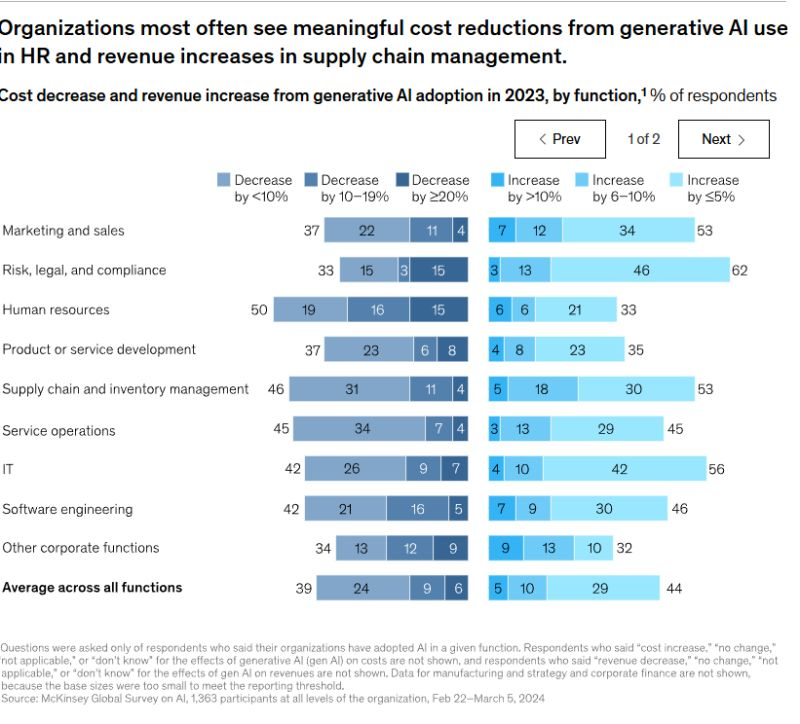
The intersection of artificial intelligence and human resources represents a pivotal shift in how organizations manage their most valuable asset: people. According to McKinsey & Company's 2024 State of AI report, HR departments are experiencing some of the largest cost reductions from AI implementation, with high-performing companies reporting an impressive 20%+ year-over-year savings. Despite this compelling evidence, many HR teams continue to underutilize AI's potential to drive efficiency and EBIT growth. The transformation at hand isn't about replacing HR professionals—it's about eliminating administrative burdens, optimizing workforce costs, and enabling HR teams to focus on high-value strategic initiatives that directly impact business outcomes. As organizations navigate this technological revolution, those who strategically implement AI within their HR functions are positioned not just to cut costs but to fundamentally transform how they attract, develop, and retain talent in an increasingly competitive market.
AI-Powered Employee Self-Service: Slashing Administrative Burdens
The administrative workload that has traditionally bogged down HR departments is experiencing a radical transformation through AI-powered self-service solutions. These technologies aren't simply automating tasks—they're redefining the entire HR service delivery model while driving significant cost reductions.
Gartner reports that organizations implementing AI portals for payroll, benefits, PTO, and compliance functions are seeing a 30-50% reduction in HR administrative workloads. This dramatic decrease allows HR professionals to redirect their time and expertise toward strategic initiatives that drive business growth rather than being consumed by repetitive administrative tasks.
The impact of AI chatbots on service delivery is equally impressive. Microsoft's implementation data shows that 60% of service desk inquiries can now be resolved without human intervention through AI-powered conversational interfaces. This capability not only cuts administrative costs but significantly expedites issue resolution, enhancing the employee experience while reducing overhead.
I have helped companies implement chatbots for the last couple of years and the surprise HR professionals have at the increase in engagement is funny to me. One company was completely against using bots in favor of the more human touch. The issue was that the humans could not handle the workload of request coming in during the pandemic and referring employees to an online document to read was not the best user experience. Once we implemented a bot to handle all level one cases, it increased the amount of time the team was able to spend on level two and above.
The onboarding process—traditionally paper-heavy and time-consuming—has been revolutionized through AI-powered automation. McKinsey's analysis demonstrates that organizations implementing AI-driven onboarding solutions are completing the process 40% faster than those using conventional methods. This acceleration reduces administrative costs while ensuring new employees become productive more quickly, directly impacting the bottom line.
These efficiency gains aren't just about cost reduction—they represent a fundamental shift in how HR delivers value. By leveraging AI to handle routine administrative work, HR professionals can focus on strategic initiatives like talent development, organizational design, and culture-building that directly drive business performance and competitive advantage. For more insights on this transformation, check out AI in HR: From Onboarding to Employee Experience and explore how IBM's AI-powered HR automation solutions are delivering measurable ROI across multiple industries.
Smarter, Faster Talent Acquisition: Optimizing the Hiring Funnel
The talent acquisition landscape has been fundamentally transformed by artificial intelligence, creating unprecedented efficiencies throughout the hiring process while simultaneously improving quality of hire. AI-powered solutions are revolutionizing how organizations identify, engage, and secure top talent.
LinkedIn's implementation data reveals that organizations utilizing AI-powered candidate matching technologies are experiencing a 70% reduction in resume screening time. This dramatic efficiency gain allows recruiters to focus their expertise on high-value activities like candidate engagement and selection rather than getting lost in administrative screening tasks. The technology doesn't just work faster—it works smarter, identifying candidates who might be overlooked by traditional screening methods.
Beyond candidate screening, AI has streamlined the logistical aspects of recruitment. Organizations implementing AI-powered scheduling tools are saving more than 10 hours per week through automated interview coordination. This time savings translates directly to cost reduction while accelerating the hiring process, reducing time-to-fill metrics that directly impact business continuity and performance.
Perhaps most significantly, predictive hiring analytics are fundamentally changing how organizations approach talent acquisition. By identifying best-fit candidates before hiring needs arise, these AI systems lower attrition costs by improving retention through better initial fit. The technology analyzes patterns in successful hires, identifies candidates with similar characteristics, and predicts which prospects are most likely to succeed and stay with the organization long-term.
I have been all in on AI in Recruiting since 2018. We implemented the leading AI and machine learning platform to help us go on the talent offense, leveraging the power of the AI at the time. I have brought this same product with me to two other organizations while also helping five large enterprises switch to the product. The quality of hire, speed to hire, and recruiter engagement metrics always increase by at least 25% once recruiters gain comfort in handing this stage of the process over to the more qualified AI that can do it asynchronously. This is perhaps the lowest hanging fruit for optimization with AI in HR.
The result is a more strategic, proactive approach to talent acquisition that not only reduces direct recruitment costs but minimizes the substantial indirect costs associated with poor hiring decisions, including lost productivity, retraining expenses, and cultural impact. Organizations that leverage AI throughout their talent acquisition process are gaining significant competitive advantages in securing top talent while optimizing recruitment spending. Concerned about AI's broader impact on employment? Read more about Job Openings Vanishing: Is AI to Blame? and discover how implementing AI in recruitment can be done ethically and effectively.
Workforce Cost Optimization: Strategic Resource Allocation
AI-powered workforce management represents a paradigm shift in how organizations optimize their human capital investments. These technologies enable unprecedented precision in workforce planning, compensation strategies, and retention initiatives—all driving significant cost optimization without sacrificing workforce effectiveness.
Real-time workforce planning platforms leverage AI to analyze productivity data, market trends, and business forecasts to prevent the costly error of over-hiring while ensuring optimal staffing levels across the organization. This precision in workforce deployment eliminates wasteful spending while ensuring sufficient resources are allocated to high-priority initiatives. According to Deloitte's Global Human Capital Trends report, organizations implementing AI-driven workforce planning are achieving 15-20% greater workforce cost efficiency compared to those using traditional planning methods.
Compensation represents one of the largest expense categories for most organizations, and AI is transforming how this investment is optimized. AI-driven compensation benchmarking ensures pay equity while optimizing salary and bonus structures to maximize return on compensation spending. McKinsey's analysis shows that organizations leveraging AI for compensation optimization are achieving 7-12% greater efficiency in their compensation expenses while improving employee satisfaction with pay fairness.
Perhaps most significantly, AI-powered attrition prediction models are revolutionizing retention strategies. These systems identify employees at risk of departure before they actively begin job searching, allowing targeted retention initiatives that prevent the substantial costs associated with turnover, training, and rehiring. Gartner estimates that each prevented departure saves organizations between 90-200% of the employee's annual salary when considering all associated turnover costs.
You do not have to have an expensive AI product to manage such a project. I am currently using Gemini and an AI Agent I built to monitor our internal trends and forecast. Rather than spending hours monthly pulling in and analyzing the data, my agent does it for me. I now have real time updates on any anomalies or concerns I should draw my attention to. I hate workforce planning surprises and my AI Agent ensures this is a worry of the past.
The strategic implementation of AI across workforce planning, compensation, and retention initiatives creates a comprehensive approach to workforce cost optimization that goes far beyond simple cost-cutting. Organizations taking this approach are achieving significant savings while simultaneously improving workforce performance, engagement, and retention—transforming HR from a cost center to a strategic driver of business performance. For a broader perspective on HR's evolution, explore HR's Future and how AI is reshaping the function, or dive into SHRM's research on AI's transformation of HR.
Looking for practical applications? Discover My Favorite AI Tool for Employee Coaching to see how AI can transform your approach to employee development, and check out Workday's AI-powered HR service delivery platform for enterprise-scale implementation insights.
Conclusion
The AI revolution in HR isn't merely a technological shift—it's a fundamental transformation in how organizations manage their most valuable asset: people. As demonstrated by McKinsey's research showing 20%+ year-over-year savings for high-performing companies, AI represents HR's biggest cost-saving opportunity while simultaneously enabling strategic value creation.
The evidence is clear: AI-powered employee self-service is reducing administrative workloads by 30-50%, AI-driven talent acquisition is cutting screening time by 70%, and workforce optimization is delivering significant cost efficiencies across planning, compensation, and retention initiatives. These aren't incremental improvements—they represent a complete reimagining of the HR function.
Forward-thinking HR leaders recognize that AI isn't about replacing the human element in human resources but rather augmenting it. By eliminating administrative burdens and enabling data-driven decision-making, AI empowers HR professionals to focus on strategic initiatives that directly drive business performance: crafting exceptional employee experiences, developing future-ready talent, and building organizational cultures that attract and retain top performers.
The question facing HR leaders is no longer whether to implement AI, but how quickly and effectively they can leverage these technologies to capture the tremendous cost savings and strategic advantages they offer. Those who move decisively to integrate AI throughout their HR functions will position their organizations for competitive advantage through both cost leadership and talent excellence.
As the business landscape continues to evolve at an accelerating pace, one thing is certain: HR teams that leverage AI aren't just cutting costs—they're fueling business growth and redefining what's possible in human capital management.
Interested in more strategic HR insights? Explore how AI is reshaping compensation strategies and discover what the future of HR looks like in the era of advanced technology. Don't settle for conventional HR practices when you could leverage game-changing methodologies that deliver measurable results and competitive advantage. Schedule some time for a free consultation.
Join our mailing list
Get the latest and greatest updates to your inbox!
About the Author
Human Capitalist
About The Author
As a recognized authority in Human Capital, I'm passionate about how AI is transforming HR and shaping the future of our workforce. Through my books Sprint Recruiting: Innovate, Iterate, Accelerate and High-Performance Recruiting, I've introduced agile methodologies that help organizations thrive in today's rapidly evolving talent landscape.
My research in AI-powered people analytics demonstrates that HR must evolve from administrative functions to strategic business partnerships that leverage technology and data-driven insights. I believe organizations that embrace AI in their HR practices will gain significant competitive advantages in attracting, developing, and retaining talent.
Through my podcast, The Human Captialist, and speaking engagements nationwide, I'm committed to helping HR professionals prepare for workplace transformation and technological disruption. Connect with me at www.trentcotton.com or linktr.ee/humancapitalist to learn how you can position your organization for the future of work.