
- Nov 14, 2024
The Rise of the Humans: Why Generative AI is Making Soft Skills More Important Than Ever
- Trent Cotton
- 0 comments
The world of work is changing. Rapidly. Generative AI (GAI) is no longer a futuristic fantasy; it's here, it's real, and it's transforming industries at an unprecedented pace. But while many fear AI will replace human jobs, the reality is far more nuanced. GAI is not just about automation and increased productivity. It is fundamentally shifting the skills required, placing a premium on uniquely human traits – soft skills.
Think creativity, critical thinking, communication, and collaboration – these are the skills that will define success in the age of AI. Why? Because while AI can process information and perform tasks with incredible speed and accuracy, it still lacks the capacity for empathy, judgment, and nuanced understanding that humans possess.
The Changing Face of the Workforce
As GAI automates routine and repetitive tasks, the demand for employees who can navigate complex situations, solve problems creatively, and connect with others on an emotional level is skyrocketing. This shift is not just speculation; it's backed by hard data.
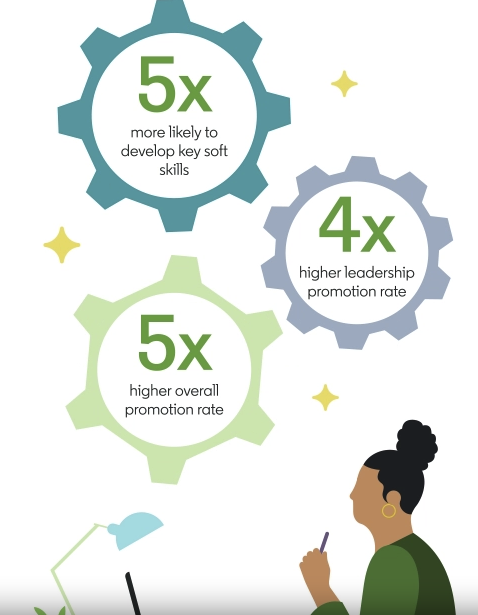
A recent LinkedIn study found that employees skilled at using GAI are five times more likely to develop crucial soft skills like creative ideation, design thinking, and emotional intelligence. This suggests that interacting with and leveraging AI tools actually fosters the growth of these essential human skills.
In fact, companies with a higher proportion of GAI-skilled employees experience significantly higher promotion rates – four times higher for leadership roles and five times higher overall. This is just one trend showing the growing value placed on individuals who can effectively integrate AI into their work and leverage its capabilities to drive innovation and growth.
Source: LinkedIn
Generative AI and Soft Skills: The Human Edge in an AI World
The world of work is changing. Rapidly. Generative AI (GAI) is no longer a futuristic fantasy; it's here, it's real, and it's transforming industries at an unprecedented pace. But while many fear AI will replace human jobs, the reality is far more nuanced. GAI is not just about automation and increased productivity. It is fundamentally shifting the skills required, placing a premium on uniquely human traits – soft skills.
Think creativity, critical thinking, communication, and collaboration – these are the skills that will define success in the age of AI. Why? Because while AI can process information and perform tasks with incredible speed and accuracy, it still lacks the capacity for empathy, judgment, and nuanced understanding that humans possess.
The Changing Face of the Workforce
As GAI automates routine and repetitive tasks, the demand for employees who can navigate complex situations, solve problems creatively, and connect with others on an emotional level is skyrocketing. This shift is not just speculation; it's backed by hard data.
A recent LinkedIn study found that employees skilled at using GAI are five times more likely to develop crucial soft skills like creative ideation, design thinking, and emotional intelligence. This suggests that interacting with and leveraging AI tools actually fosters the growth of these essential human skills.
In fact, companies with a higher proportion of GAI-skilled employees experience significantly higher promotion rates – four times higher for leadership roles and five times higher overall. This is just one trend showing the growing value placed on individuals who can effectively integrate AI into their work and leverage its capabilities to drive innovation and growth.

Why Soft Skills Matter More Than Ever
The rise of GAI is not about replacing humans; it's about augmenting human capabilities. By automating mundane tasks, AI frees up employees to focus on higher-level thinking, strategic planning, and creative problem-solving. This requires a workforce equipped with strong soft skills:
Critical Thinking and Problem-Solving
AI can provide data and insights, but it takes human intelligence to analyze that information, identify patterns, and make informed decisions. According to the World Economic Forum's Future of Jobs Report 2023, analytical thinking and creative thinking are among the top 10 skills expected to be in high demand over the next five years.
Creativity and Innovation
GAI can generate ideas and content, but it takes human ingenuity to refine those outputs, connect seemingly disparate concepts, and develop truly innovative solutions. The McKinsey Global Institute found that jobs requiring creativity and innovation will see much less displacement from automation than routine tasks.
Communication and Collaboration
As AI becomes more integrated into workflows, the ability to effectively communicate with both humans and machines becomes crucial. Collaboration skills are also essential, as teams will need to work together to leverage AI's potential fully. These skills become even more critical when navigating the impact of AI on white-collar jobs, where effective collaboration between humans and AI is redefining professional roles.
Emotional Intelligence and Empathy
In a world increasingly reliant on technology, the ability to understand and respond to human emotions becomes even more vital. Empathy and emotional intelligence are critical for building strong relationships, navigating complex social dynamics, and leading effectively. According to Harvard Business Review, "as AI takes over more analytical and process-driven work, the human workforce will increasingly need to bring emotional skills to the table."
Forward-Thinking Companies Are Already Adapting
Recognizing this shift, forward-thinking companies are proactively investing in reskilling their workforce and prioritizing soft skills in their hiring processes. They understand that the future of work is not about competing with AI, but about collaborating with it.
These companies are implementing training programs focused on developing essential soft skills, such as communication, collaboration, and critical thinking. They are also redesigning their hiring processes to assess candidates' soft skills, using behavioral interviews, simulations, and assessments to identify individuals with the right mix of technical and human capabilities.
For instance, according to a recent report by the National Skills Coalition, "States like Indiana and Colorado are investing in sector partnerships that bring together employers, educators, and workforce development organizations to identify in-demand skills and develop training programs that align with industry needs." This proactive approach ensures that their workforce remains relevant and adaptable in the face of rapid technological advancements.
AI-powered recruiting tools are even being used to better identify and assess these soft skills in candidates, creating a more holistic evaluation process that values both technical expertise and human capabilities.
The Future of Work is Human
As Stephanie Conway, LinkedIn's Senior Director of Talent Development, aptly puts it:
"Creating readiness for AI adoption requires companies to take a systemic approach. Providing opportunities to apply gen AI in the flow of work (the what) needs to be combined with a focus on human skill development, in particular growth mindset, innovation, and resilience (the how). Underpinned by a culture of continuous learning, from new hires to senior executives (the who), 'learning to learn' will become a critical skill for organizations as they develop talent that can adapt to the fast-evolving workplace."
The rise of GAI is not a threat to human employment; it's an opportunity to redefine the very nature of work. By embracing AI and investing in soft skills development, we can create a future where humans and machines work together, each leveraging their unique strengths to achieve greater innovation, productivity, and success.
A study by Deloitte reinforces this view, noting that as automation increases, the most successful organizations will be those that prioritize "uniquely human capabilities" and create environments where humans and machines complement each other.
This shift requires a fundamental rethinking of how we approach leadership development and talent management. Leaders who understand this new paradigm – who can effectively bridge the gap between human potential and technological advancement – will be the ones who drive their organizations forward in the age of generative AI.
As we navigate this transition, it's essential to remember that while technology will continue to evolve and transform the workplace, the human element – with all its creativity, empathy, and adaptability – remains irreplaceable. The future of work is not about AI or humans; it's about AI and humans, working together to create something greater than either could achieve alone.
For more insights on navigating the AI revolution in the workplace, check out our articles on AI in HR processes and separating AI fact from fiction.

Join our mailing list
Get the latest and greatest updates to your inbox!
About the Author
Human Capitalist
About The Author
As a recognized authority in Human Capital, I'm passionate about how AI is transforming HR and shaping the future of our workforce. Through my books Sprint Recruiting: Innovate, Iterate, Accelerate and High-Performance Recruiting, I've introduced agile methodologies that help organizations thrive in today's rapidly evolving talent landscape.
My research in AI-powered people analytics demonstrates that HR must evolve from administrative functions to strategic business partnerships that leverage technology and data-driven insights. I believe organizations that embrace AI in their HR practices will gain significant competitive advantages in attracting, developing, and retaining talent.
Through my podcast, The Human Captialist, and speaking engagements nationwide, I'm committed to helping HR professionals prepare for workplace transformation and technological disruption. Connect with me at www.trentcotton.com or linktr.ee/humancapitalist to learn how you can position your organization for the future of work.