TL;DR
Short answer: It depends how you define the threat, and the honest answer is worse than getting fired. monday.com cut 620 people, about 20% of its workforce, while the company was profitable and growing. Leadership called it a redesign for AI, not a turnaround: fewer management layers, more autonomous teams, broader ownership. That list is an org design project, and org design is HR's job. When the CEO doesn't call HR into that room, HR has already been bypassed, whether or not anyone lost a title.
Key stats you need to know:
- monday.com cut roughly 620 employees, about 20% of its global workforce, according to reporting on the company's July restructuring announcement (Business Insider; CIO).
- Q2 2026 revenue came in at $364.6 million, up 22% year over year, three weeks after the cuts were announced (monday.com investor relations).
- Leadership told investors the savings from the cuts are going back into talent, products, and AI, not into margin improvement (Business Insider).
The leadership takeaway: Over the next 12 to 24 months, the workforce decisions that matter most at your company will get made by whoever owns org design, and if that isn't HR by default anymore, someone has to fight to make it HR by design.
📺 Watch the full breakdown on The Human Capitalist: https://youtu.be/3_w9yBoZGjU
🎧 Listen on Spotify: https://open.spotify.com/show/57xtYAUsIYrg7gQ0a6RFwc
➡️ Catch past episodes in this series, including A CEO Just Fired His Entire HR Team… Here's Why and Why Bolt's CEO Fired HR and the 5 Mindsets Every CHRO Needs Now
Is Monday.com's Restructuring Actually an AI Story, or an Org Design Story?
It is an org design story wearing an AI headline, and the numbers back that up. monday.com's co-founders framed the 620 cuts as building "a faster, flatter company with clearer priorities," not a response to financial trouble (monday.com investor relations). Business Insider reported the line that made me stop scrolling: "Improving margins was not the purpose of this decision. We intend to reinvest the vast majority of the savings in our talent, our products, AI, and future growth" (Business Insider).
This wasn't a company in crisis. Q2 revenue hit $364.6 million, up 22% year over year, three weeks after the layoffs (monday.com investor relations). That's capital reallocated into product and AI instead of headcount, the shift I mapped in Is Headcount Planning Broken? Revenue grew 22% while headcount fell 20%. If your workforce plan runs on a historical headcount ratio, that ratio already broke.
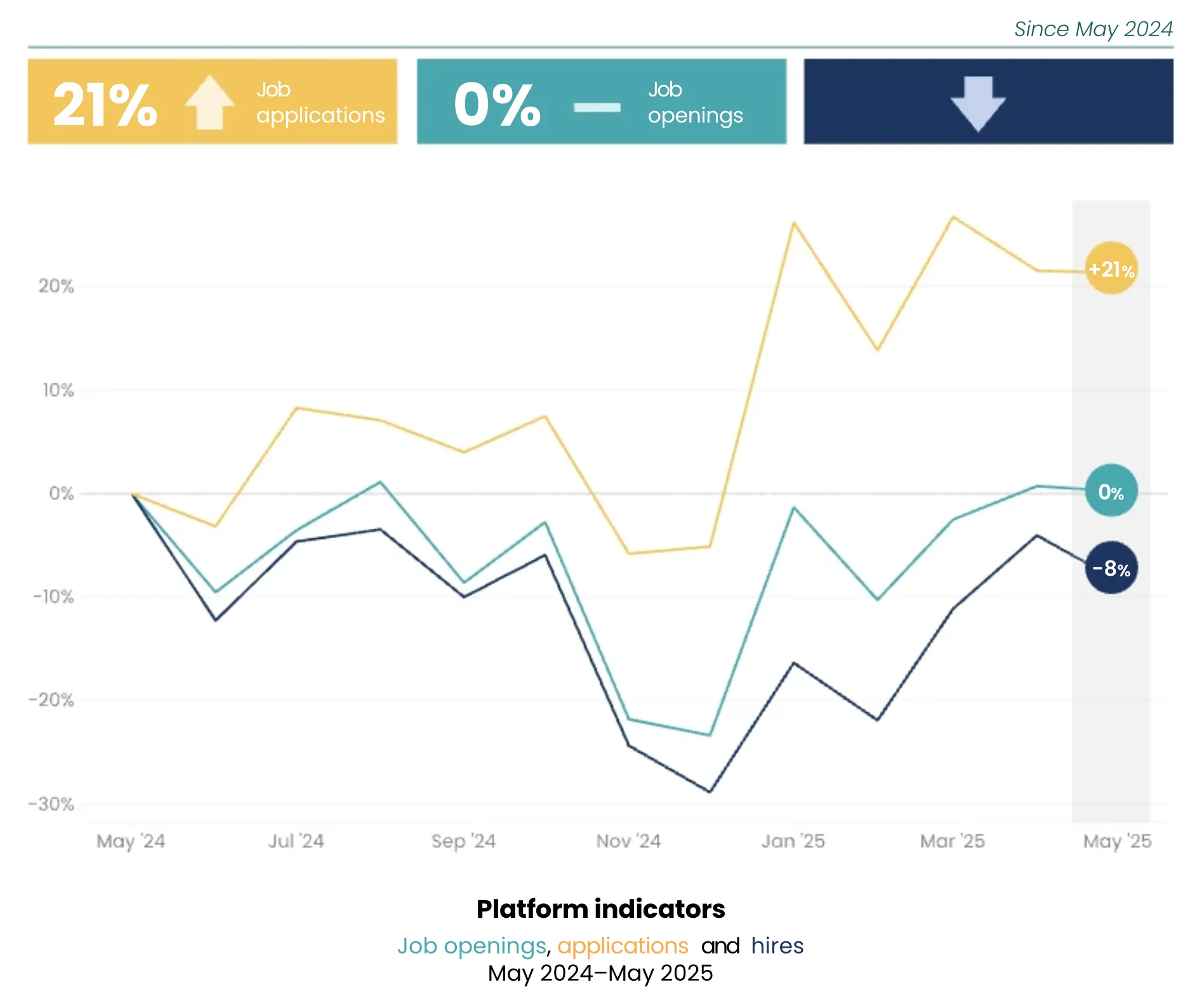
The pattern holds at scale too. The World Economic Forum's Future of Jobs Report 2025 projects structural labor-market change will touch 22% of today's jobs by 2030, split between 170 million created and 92 million displaced, and finds 40% of employers expect to reduce headcount where AI can automate tasks (World Economic Forum). monday.com isn't an outlier. It's an early case of a pattern I traced through hiring data in Is Your Workforce Splitting Into Two Tracks?
What Is the Architect Mindset, and Why Does monday.com's Plan Look Like One?
The Architect mindset is one of five ways of operating I outline in my book, "The FutHRist," and it means starting a workforce decision with the organization you're trying to build rather than the positions you're trying to cut (The Human Capitalist). An Architect doesn't open with "which roles go." An Architect opens with how many layers the company needs, where decisions should live, and which teams own what.
Read monday.com's own language back through that lens, forgetting AI for a second: fewer management layers, more autonomous teams, broader ownership, a redesigned go-to-market model with more hands-on customer support (Business Insider). Layers, spans of control, role architecture, ownership boundaries. That's an org design project, and org design has always been core HR discipline, the same discipline I described leaders needing to rebuild in Was HR Built for a Workforce That No Longer Exists?
I can't prove whether monday.com's HR team authored this plan or got handed the outcome. What I can point to is who's positioned as the architect now: the co-founders, not HR leadership. In a boardroom, I'd say it this way: someone is always going to answer "how many layers do we need and where do decisions live." The only open question is whether that someone reports into HR or works around it.
How Should C-Suite Leaders and CHROs Respond to Prevent Getting Bypassed?
C-suite leaders and CHROs should respond by answering four questions before their CFO does, because those questions are coming to a planning meeting near you whether HR is in the room or not.
- Which jobs actually change. Stop modeling AI at the department level. "AI will transform HR" tells nobody what to do Monday morning. Go role by role: what happens to a recruiter, a CSM, an analyst, or a first-line manager, broken into how much of that role is retrieval, coordination, or judgment. I built a tool for exactly this call, the Value of Work Matrix, because mapping the org is Architect work, not a slogan.
- Where output can grow without headcount growing. If revenue is up 20%, ask where headcount doesn't need to follow. Where do ten people with better systems produce what fifteen used to? That turns a headcount request into a productivity model.
- Where human judgment is worth protecting. Not every task should get automated. Know precisely where a person creates value a system can't, and defend that with evidence.
- Where AI is riskier than it looks. A decision that looks cheaper on a spreadsheet gets expensive once it touches legal exposure or employee relations. This is Scientist mindset work: test the assumption, price out the cost when it's wrong.
Answer those four honestly and you stop defending headcount and start telling your board what the org should look like 18 months out. That's a seat that stays in the room, the discipline I described in Is HR Becoming Irrelevant?
What This Means for You as a Leader
The tension underneath the monday.com story is that AI isn't erasing HR's seat at the table so much as quietly filling it with whoever answers the org design questions first. Getting fired is loud. Getting bypassed is quiet: you keep your job, your title, and your team, while the decisions that reshape the workforce get made in a room you weren't invited into.
Winning here doesn't require predicting AI perfectly. It requires mapping the work, testing last year's headcount assumptions, and showing up with a productivity number instead of a defense of the status quo. Leaders who do that keep authoring the org chart. Leaders who don't will read about their own restructuring in the same press release everyone else does, the same blind spot I traced in Is HR Anti-Worker, or Just Poorly Built?
One honest caveat before this gets filed under "growth story." Analysts flagged that monday.com's net dollar retention fell to a record low the same quarter it posted that 22% revenue growth (Tech Times). Sizzle and steak can sit in the same earnings call.
I walk through the full breakdown on this week's episode of The Human Capitalist. Want to know which of the five FutHRist mindsets you're operating in right now? The self-assessment takes about eight minutes (Become a FutHRist).
FAQ
Is HR being fired or replaced by AI at monday.com?
Neither, based on what's public. monday.com never published a role-level breakdown of the 620 cuts, so any claim about which functions were hit is speculation (Business Insider). What's visible is an org redesign, fewer layers and more autonomous teams, that reads like a workforce planning decision rather than a straight AI-for-jobs swap.
Why did monday.com cut 20% of its workforce while growing 22%?
Because the co-founders framed the cuts as reinvestment, not cost-cutting. The memo stated the goal was reinvesting the savings into talent, products, and AI rather than improving margins (Business Insider), and Q2 revenue still grew to $364.6 million, up 22% year over year (monday.com investor relations).
What is the Architect mindset in simple terms?
It's one of five mindsets in my book "The FutHRist," and it means starting workforce decisions with the organization you want to build rather than the positions you want to cut. An Architect asks how many layers the company needs and where decisions should live before touching a single headcount number (The Human Capitalist).
Is getting bypassed the same thing as being irrelevant?
Not yet, but it's the on-ramp. Getting bypassed means you keep your job and your title while the decisions that reshape the workforce happen in rooms you're not in. Nobody sends a memo announcing it. You just quietly stop being the person people call when those calls need to be made.
What should CHROs and CEOs do first?
Pick one function and answer four questions honestly: which roles actually change, where output can grow without headcount growing, where human judgment is worth protecting, and where AI is riskier than it looks. Bring evidence for each answer instead of an opinion, and you'll have a workforce plan your CFO didn't have to ask for.
I talk through frameworks like the Architect and Scientist mindsets every week on The Human Capitalist. The full five-mindset breakdown is part of my book, "The FutHRist," dropping September 14, 2026. Find where you stand with the eight-minute assessment at trentcotton.com/futhrist-start-here.