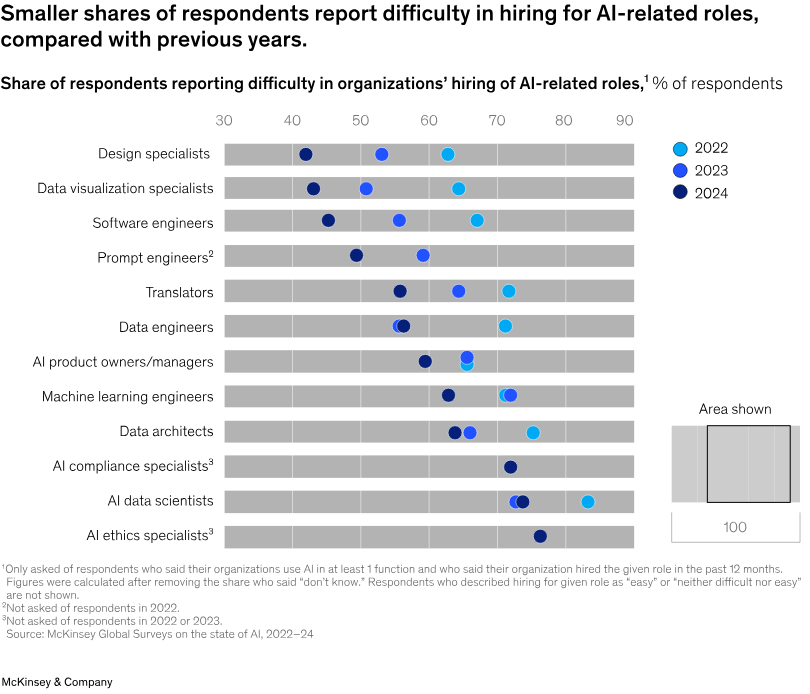
The conventional narrative surrounding tech talent acquisition has centered on scarcity and premium compensation packages. However, recent data from McKinsey's Global Surveys reveals a counterintuitive trend: organizations are reporting significantly decreased difficulty in securing tech talent compared to previous years. This market correction – not crisis – represents a fundamental shift that forward-thinking HR leaders must leverage for competitive advantage in both cost efficiency and access to qualified candidates as we approach 2025.
The Data-Driven Reality: Tech Hiring Difficulty is Declining
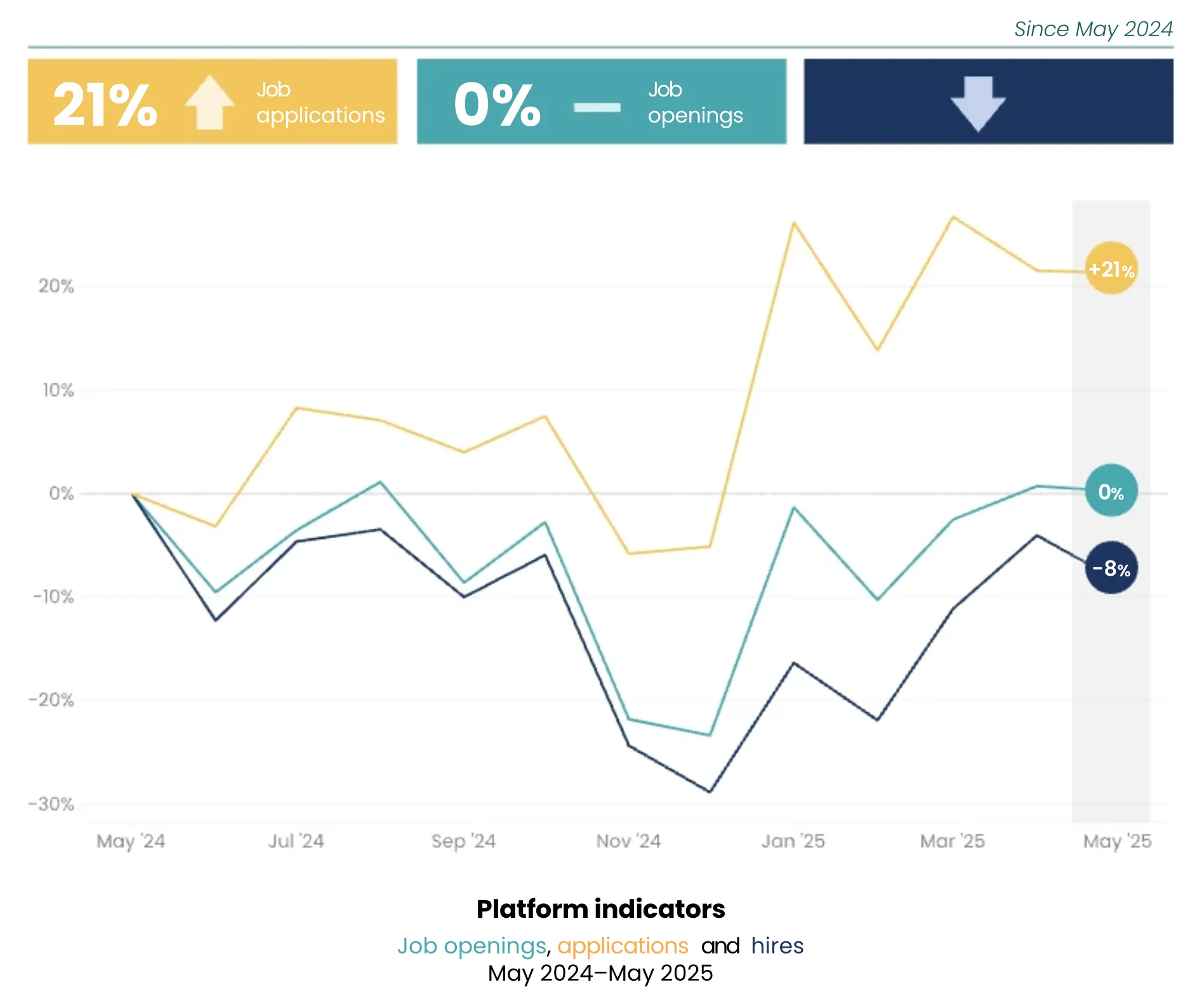
Recent McKinsey data shows a consistent pattern of easing recruitment challenges across tech roles. Design specialists experienced a dramatic drop in hiring difficulty from 62% in 2022 to 37% in 2024, while software engineers followed a similar trajectory, decreasing from 65% to 40%. Gartner's 2024 Technology Workforce Trends Report confirms this shift, with 63% of organizations reporting improved ability to attract and retain technology talent compared to 2022 levels. This aligns with insights from our recent analysis on "Job Openings Vanishing: Is AI to Blame?", which explores how AI is reshaping the job market. The transformation demands an immediate strategic pivot, as organizations operating under outdated assumptions about tech talent scarcity risk misallocating resources toward recruitment efforts that no longer require premium investment.
Market Forces Driving the Tech Talent Normalization
Three primary market forces have converged to drive this unexpected normalization in tech talent availability. First, the tech sector realignment of 2023-24 has fundamentally shifted power dynamics, with McKinsey's analysis indicating over 260,000 technology professionals were displaced during this period. This aligns with our findings in "AI's Impact on White Collar Jobs", which examines these structural changes. Second, educational institutions have rapidly optimized their talent pipelines, with the World Economic Forum's Future of Jobs Report showing a 217% increase in AI-specific degree and certification programs between 2020 and 2023. Finally, as explored in "The Great Reskilling", cross-functional skill development has expanded the potential talent pool beyond traditional role boundaries, with IBM's Global AI Adoption Index reporting 72% of organizations implementing internal AI upskilling programs.
Strategic Pivots for Tech Talent Acquisition in 2025
Organizations must make three strategic pivots to capitalize on this market correction. First, compensation benchmarks need recalibration against current market data. McKinsey's salary analytics indicate organizations using 2022 compensation bands for tech roles are potentially overpaying by 18-24%. This insight connects with our analysis in "AI's Impact on the Workforce", which details how AI is reshaping compensation structures. Second, focus should shift to internal development, as Deloitte's 2024 Human Capital Trends report shows organizations investing in internal tech talent development achieve 31% higher retention rates. Third, as detailed in "AI in HR: From Onboarding to Employee Experience", organizations must reframe their employee value propositions beyond compensation, as high-performing tech professionals now prioritize meaningful implementation opportunities (68%) and clear developmental pathways (61%) above pure compensation.
Conclusion
The tech talent landscape isn't in crisis – it's normalizing. This correction presents an opportunity for organizations to fundamentally reassess their tech talent acquisition strategies. Success in 2025 will require eliminating unnecessary premiums for commoditizing roles, leveraging internal development opportunities, and implementing bifurcated acquisition approaches that distinguish between generalized and specialized roles. The question isn't whether the tech talent market is changing – the data clearly shows it has already changed. The question is whether your organization will lead or lag in responding to this fundamental shift.