TL;DR
Short answer: Yes. CHROs need to co-own AI strategy because AI changes work design, decision rights, accountability, and workforce capability. When the CHRO is excluded, the business is building an AI operating model without defining the human system that makes it safe, credible, and productive.
Key stats leaders need to know
- 46% of organizations do not involve the CHRO when AI strategy is being defined.
- 71% of CHROs say supervising, validating, and overriding AI output is the most essential workforce skill. Only 29% of employees rank judgment as important.
- 60% of employees worry AI is eroding their skills, with critical thinking cited most often as a declining capability.
- Organizations that clearly distinguish human-led, AI-assisted, and AI-executed workflows report 18% risk reduction and 20% quality improvement.
The leadership takeaway: AI strategy is workforce strategy once it changes how decisions are made and who is accountable when the system gets something wrong. CEOs, CHROs, CIOs, and COOs need to design that operating model together before a technology decision hardens into a people problem.
Is excluding the CHRO from AI strategy a governance failure?
Yes. Leaving the CHRO out of AI strategy is a governance failure because AI implementation redistributes work, authority, risk, and accountability across the enterprise.
The IBM Institute for Business Value and Oxford Economics surveyed 1,500 CHROs and equivalent workforce executives across 21 geographies and 23 industries, alongside 8,800 full-time employees in 28 countries. The headline figure should make every executive team uncomfortable: 46% of organizations do not involve the CHRO when AI strategy is being defined. IBM’s CHRO study lays out why that matters.
That number will tempt the usual debate about whether HR has finally earned a strategic seat at the table. I have little patience for that framing. It turns a business-design problem into an HR-status contest.
The better question is simpler: who is deciding how work will change?
AI strategy now determines which work stays human-led, which work becomes AI-assisted, and which work becomes AI-executed. It affects job scope, decision rights, control mechanisms, escalation paths, learning requirements, performance expectations, employee trust, and the mechanics of accountability.
That is workforce architecture and a job of the FutHRist Architect mindset.
A company cannot credibly say, “Our AI is human in the loop,” then leave unanswered questions such as:
- Who validates AI output before it affects a customer, employee, or business decision?
- Who has authority to override a recommendation?
- What signals require an exception or escalation?
- How much time does validation add to the role?
- Is that extra work visible in workload planning and performance expectations?
- What happens when someone challenges the system and leadership prefers the faster answer?
IBM’s study shows why this matters. Forty-three percent of employees say that when AI goes wrong, the blame falls on them. Forty-one percent of CHROs believe employees may not feel safe challenging or overriding AI output. IBM’s CHRO study
This is not a minor "adoption" issue, although it's easy to sweep it under the rug with that mentality. It means companies may be asking employees to carry liability for systems they did not select, cannot fully inspect, and may lack the authority to challenge.
The pattern gets more concerning when viewed alongside coordination data. Only 28% of CHROs say they have a joint roadmap with IT backed by a shared operating cadence, while 73% say coordinating consistently across the C-suite is difficult.
AI governance has become too focused on models, policies, and approval committees. Those matter. But policy does not tell a manager what to do when an AI-generated recommendation is plausible, influential, and wrong.
Work design does but work design has changed as AI has come into the picture.
The organizations creating real value from AI are not simply turning on more tools. They are redesigning workflows, decision-making, and workforce capability around people and technology. IBM reports that organizations which clearly classify workflows as human-led, AI-assisted, or AI-executed achieve 18% risk reduction and 20% quality improvement.
That is why CHRO AI strategy is not about HR getting invited to a technology meeting. It is about ensuring the enterprise defines the human-accountability model before it scales automation.
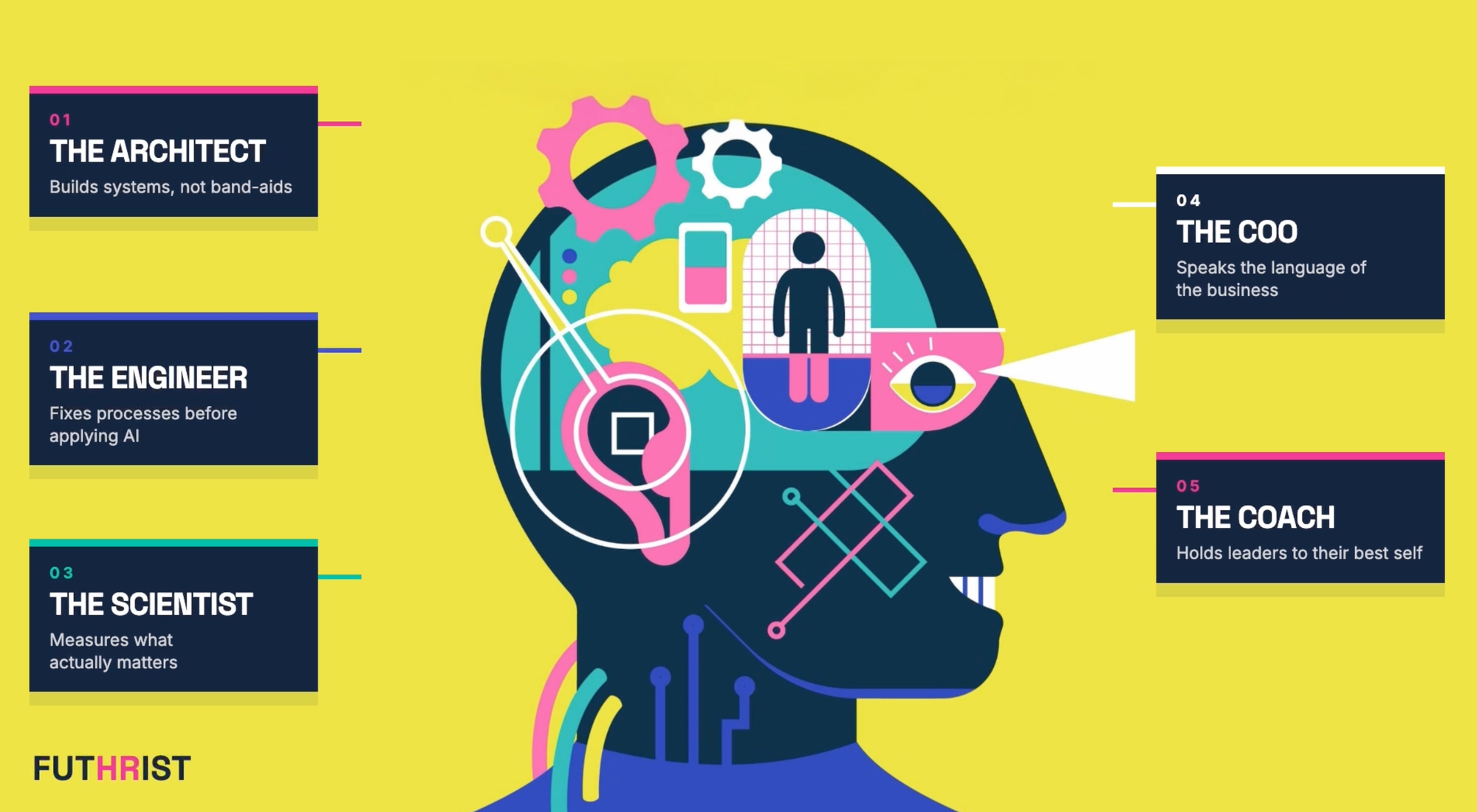
What do the Five FutHRist Mindsets reveal about AI workforce governance?
The Five FutHRist Mindsets provide a practical leadership lens for AI workforce governance because they force CHROs to think beyond adoption and into operating-model design.
In The FutHRist: 5 Mindsets of the Future HR Pro, I made the case that future-ready HR leaders need to shift how they see the work. That argument becomes more urgent in an AI economy. The question is no longer whether AI will touch workforce strategy. It already has. The question is whether the CHRO will treat AI as another HR technology implementation or as a redesign of how the organization creates value.
The IBM data makes the gap visible. Seventy-one percent of CHROs identify the ability to supervise, validate, and override AI output as the workforce’s most essential skill. Yet only 29% of employees identify judgment as important.
That disconnect is the heart of the problem.
Employees may understand AI primarily as a productivity tool: write faster, summarize faster, produce more, complete the task. Leaders increasingly need them to use it as a decision-support system that requires discernment, context, skepticism, and accountability.
Those are very different expectations. The Five FutHRist Mindsets help translate the difference into executive action.
The FutHRist Scientist Mindset
The FutHRist Scientist mindset asks what the data is actually telling us about the future capability system.
IBM found that 60% of employees worry AI is eroding their skills. Among employees who hold that concern, three out of four say AI has already begun eroding at least some of their capabilities. Critical thinking is the most frequently cited declining skill.
That should end the lazy assumption that AI adoption automatically creates a more capable workforce.
If AI completes the first draft, frames the problem, synthesizes the evidence, and recommends the answer, employees can lose repeated opportunities to practice the thinking that turns experience into judgment. An adoption dashboard can look strong while the organization weakens its capacity to challenge a bad recommendation.
The FutHRist Scientist measures more than usage. I would want to know:
- Where is AI improving decision quality, not merely speed?
- Which roles are losing practice in analysis, problem framing, and independent judgment?
- Where are early-career employees building expertise if AI now handles the developmental work?
- What types of errors are humans catching, and which errors are passing through?
- Are people becoming more confident because they understand the system, or more compliant because they do not feel safe challenging it?
The useful metric is not, “How many employees are using AI?”
It is, “Where is AI expanding human judgment, and where is it quietly replacing the practice that produces judgment?”
The COO mindset
The COO mindset brings AI governance down from the policy deck and into the workflow.
A real operating model defines who does the work, where decisions occur, what authority each role holds, how exceptions move, and how performance is measured. AI belongs inside that same discipline.
IBM found that 80% of CHROs believe AI creates invisible work for employees, including validating recommendations, fixing errors, providing context, and managing exceptions. At the same time, 42% of employees say AI is increasing their workload or that the work it adds is not recognized. IBM’s CHRO study
There is the operational risk in plain sight.
Companies celebrate the time an AI tool saves, then ignore the new quality-control labor it creates. Someone must check the output. Someone must supply missing context. Someone must identify the edge case. Someone must own the customer impact, employee consequence, or business decision after the system produces a recommendation.
That labor is not optional. It is simply being hidden inside existing jobs.
The COO mindset makes it visible. Every significant AI-enabled workflow needs answers to five questions:
- What work is human-led, AI-assisted, or AI-executed?
- Who reviews output before it affects a decision or stakeholder?
- Who can override the system, and under what conditions?
- How is validation time reflected in workload, role design, and performance goals?
- How are overrides captured and used to improve the process?
This is where the CHRO becomes indispensable. Job architecture, capability building, performance management, organizational design, employee relations, leadership behavior, and workforce planning are all part of the control environment.
The other three mindsets
The other FutHRist mindsets matter because AI transformation will fail when leaders treat it as a technical rollout.
- The Engineer maps out the handoffs and what business outcomes, effective capacity, workforce risk, and value creation chains are screwed up rather than chasing isolated productivity claims.
- The Architect redesigns roles, teams, decision rights, and career paths around the real work, including the invisible work AI creates.
- The Coach ensures leaders' behaviors are driving the firm towards enterprise value, having the tough conversations that real coaches have.
IBM’s evidence supports that last point directly. Where the CHRO at least shares responsibility for deciding which work remains human-led, 76% of employees feel safe questioning or overriding AI recommendations. Where HR is merely advisory, only 43% feel safe doing so.
That is a 33-point gap in psychological safety around AI oversight. Governance that employees cannot exercise is not governance. It is a slide in a steering-committee deck.
📚 The FutHRist is now available on Amazon, Kindle, and soon, on Audible. Find it here.
How should CHROs and C-suite leaders govern AI workforce strategy?
CHROs and C-suite leaders should govern AI workforce strategy by designing the human-accountability system alongside the technology, with clear work classifications, decision rights, capability expectations, and measures for quality and workforce risk.
The organizations that get this right will avoid the false choice between innovation and control. They will use governance to make adoption faster, more trusted, and more useful.
1. Classify the work before scaling the tool
Require every material AI initiative to classify activities as human-led, AI-assisted, or AI-executed.
This sounds simple because it is simple. That is also why it works. The classification forces leaders to decide where human judgment is essential and where automation is appropriate.
A recruiting example makes the point. AI may assist with interview scheduling, candidate communication drafts, job-description analysis, and talent-market research. It should not quietly become the unexamined decision-maker for candidate quality, compensation exceptions, or suitability in a way that leaves no accountable human owner.
The classification must include the criteria for moving work from one category to another. Without that discipline, organizations drift from assistance to delegation because the output looks plausible and the pressure to move faster is real.
For related context, read 5 Things CHROs Must Do Before the Next AI Agent.
2. Make override authority explicit
Do not tell employees they are responsible for AI oversight unless they have the authority, time, capability, and protection to challenge the output.
The IBM research found 36% of CHROs say unclear accountability complicates AI deployment. IBM’s CHRO study That number should be lower. The accountability chain needs to be built into the workflow, not recovered after a failure.
Every high-impact workflow should document:
- The accountable business owner.
- The role responsible for validating output.
- The threshold for escalation.
- The authority to override a recommendation.
- The process for documenting and learning from overrides.
- The protection available to employees who raise a concern.
If the answer is “the manager will use judgment,” the design work is incomplete. Which manager? With what data? Within what time frame? Against which performance objective? With what consequence if they challenge the automated recommendation?
A company cannot outsource accountability to a job title.
3. Build judgment as a workforce capability
AI fluency without judgment just helps an organization make mistakes faster.
That is not my line. It comes from Dr. Amit Das, Director and CHRO at Bennett Coleman & Co., featured in IBM’s study. IBM’s CHRO study It is worth repeating because it punctures a lot of AI-skills theater.
Organizations need to train employees to:
- Frame the business problem before asking AI for an answer.
- Evaluate source quality, assumptions, and missing context.
- Recognize when an output conflicts with domain knowledge or stakeholder reality.
- Escalate uncertainty rather than manufacture confidence.
- Explain the rationale behind a final decision.
- Use AI to challenge and improve their thinking, rather than avoid thinking altogether.
This is especially important for managers and early-career talent. Managers are often responsible for translating strategy into daily work. Early-career employees are still building the pattern recognition that experienced colleagues developed through repetition, feedback, and imperfect first attempts.
If AI does all the first attempts, leaders must deliberately redesign how people learn.
4. Measure invisible work and skills erosion
Productivity claims deserve a tougher standard.
When AI saves time in one part of a process but creates validation, remediation, exception handling, and stakeholder-management work elsewhere, leaders need to measure the whole workflow. Otherwise, the enterprise celebrates a local productivity gain while transferring complexity onto employees.
MeasureLeadership questionDecision qualityDid AI improve the accuracy, consistency, and business impact of the decision?Human oversightHow often are people validating, correcting, or overriding outputs?Workload shiftDid AI remove work, or did it add unrecognized review and exception work?Capability healthAre employees retaining and strengthening critical thinking, problem framing, and judgment?
This is also where the Value of Work Matrix remains useful, even if I have used it often. Its central discipline still applies: map the work people actually do against the value it creates and the time it consumes. AI should remove low-value, repetitive work. It should not hide higher-risk work inside already-full jobs.
For a useful companion lens, check out Is Headcount Planning Broken? The New FTE Math.
5. Give the CHRO shared ownership, not advisory status
The IBM findings are unusually specific here: where CHROs at least share responsibility for decisions about which work remains human-led, 76% of employees say they feel safe questioning or overriding AI recommendations. That drops to 43% where HR is merely advisory. IBM’s CHRO study
That is the difference between governance by design and governance by memo.
The CHRO should not own every AI decision. Neither should the CIO, COO, general counsel, or business-unit leader. Shared ownership means each executive brings the accountability they uniquely hold:
- The CEO keeps the work connected to strategy and enterprise value.
- The COO designs workflows, controls, service levels, and execution discipline.
- The CIO or CTO ensures the technology architecture, data practices, and systems integration hold up.
- Legal, risk, and compliance establish the risk boundaries.
- The CHRO defines the workforce architecture: role redesign, skill requirements, job quality, leadership behavior, performance systems, and change adoption.
The CHRO and technology leader are not opposing sides of the AI conversation. They are co-architects of work. IBM cites Pearson CHRO Ali Peek Bebo describing the CHRO and CTO as “the power couple” because talent strategy and technology strategy need to operate as one conversation. IBM’s CHRO study
For the broader case for CHRO-level operating-model leadership, The AI Fire Drill Era: Why CHROs Need an Architect Mindset.
What this means for leaders
AI will reward organizations that treat judgment as a designed capability, not a personality trait that shows up when the system fails.
The IBM research is telling us that many leaders recognize the importance of human oversight, validation, and override. It is also telling us that employees may not understand judgment as the work AI now demands from them. That gap will produce poor outcomes unless executive teams make accountability, capability, and decision rights explicit.
I do not see this as a plea for HR to become more strategic. That language is worn out.
I see it as a warning for the C-suite. When AI strategy is defined without the CHRO, leadership is likely leaving core questions unanswered: who owns the decision, who develops the capability, who bears the risk, and who gets blamed when the automated answer fails.
The companies that win will make those choices deliberately. They will build the workforce architecture before the AI rollout becomes a workforce mess.
To continue the conversation, check out The FutHRist: 5 Mindsets of the Future HR Pro, subscribe to The Human Capitalist Podcast, and bring this question to the next AI steering meeting:
Who owns the human side of the decision after the system makes its recommendation?
FAQ
Why should the CHRO be involved in AI strategy?
The CHRO should be involved because AI changes job design, workforce capability, decision rights, performance expectations, and accountability. IBM found that 46% of organizations exclude the CHRO when AI strategy is defined, despite evidence that shared CHRO responsibility is associated with greater employee safety in questioning or overriding AI recommendations. IBM’s CHRO study
What is AI workforce governance?
AI workforce governance is the operating model that defines how people and AI share work, decisions, accountability, oversight, and escalation. It includes work classification, human-review requirements, override authority, capability development, workload design, and measurement of quality and risk.
What skills matter most in an AI-enabled workforce?
Critical thinking, problem framing, human judgment, and the ability to supervise, validate, and override AI outputs matter most. IBM found 71% of CHROs rank AI oversight and override as the most essential skill, while 57% prioritize critical thinking and problem framing. IBM’s CHRO study
Is AI creating or eroding workforce skills?
It can do both. AI can increase capacity and free people from repetitive work, but employees also report concerns about lost capability. Sixty percent worry about skills erosion, and among those concerned, three out of four say AI has already eroded some skills. IBM’s CHRO study
How can leaders prevent skills erosion from AI?
Leaders can prevent erosion by preserving deliberate practice, teaching employees to evaluate and challenge AI output, rotating people through higher-judgment work, measuring decision quality alongside speed, and making time for validation and reflection in redesigned workflows.
What should CHROs do first on AI governance?
Start by convening the CEO, COO, CIO or CTO, legal or risk leader, and business owners around a practical work-classification exercise. Identify one high-impact workflow, define what is human-led, AI-assisted, and AI-executed, then document decision rights, validation steps, escalation triggers, and capability requirements.
Resources for HR leaders
If this hit home, start here:
The FutHRist Productivity Planner (free): A weekly planning system for HR leaders leading through AI-driven change.
The FutHRist Team Scoring Workbook: Find your leadership team's blind spots before they cost you.
More tools I built for HR executives:
- AI Ethics in Recruiting (free): A framework to evaluate AI risk in your hiring stack.
- The Value of Work Matrix Toolkit: Quantify workforce decisions and defend your seat at the table.
- Sprint Recruiting Bootcamp: Cut time-to-fill without cutting quality.
- The FutHRist Team Assessment Kit: Take your HR team from never assessed to a 90-day plan.