The March Job Report for 2024 was released Friday to an anxious market. Thursday’s stock market took a dive after one of the members of the Federal Reserve indicated rate cuts were not on the horizon. Many on Wall Street were holding their breath for a “decent” jobs report. What they got was a report indicating more jobs were added than expected. The March job report painted a vivid picture of an economy in chaos yet steady.
Analyst celebrated the recent news with job additions surpassing expectations across various sectors. These figures are indicators of present health and could be signals of future direction.
This comprehensive analysis aims to unpack the nuances of the March job report, offering a lens into the sectoral achievements, the broader economic implications, and future trajectories for industries and professionals alike. If you like this type of economic information, check out some previous posts here.
Key points:
- The unemployment rate ticked down to 3.8% in March, alleviating concerns about a deteriorating labor market.
- At the same time, payroll growth continues to be very strong, with employers adding 303,000 jobs over the month.
- This strength appears to be enduring as wages continue to slow down and approach a strong but sustainable growth rate.
In March 2024, the job market’s vitality was underscored by the significant number of jobs added, surpassing prior forecasts and showcasing the economy’s robust demand for labor. This section delves into the specifics of job growth, including:
- Total Jobs Added: An impressive tally that underlines the labor market’s vigor.
- Unemployment Rate: A nuanced understanding of unemployment rates reveals the complex dynamics at play.
- Sector-Specific Growth: A close look at which sectors led the charge in job creation.
- Technology: The technology sector continued its meteoric rise, powered by breakthroughs in artificial intelligence and machine learning.
- Healthcare: With an aging demographic and heightened health awareness, healthcare saw remarkable expansions.
- Manufacturing: Green technology investments are rejuvenating manufacturing, steering it towards sustainable practices.
Wage Growth in 2024
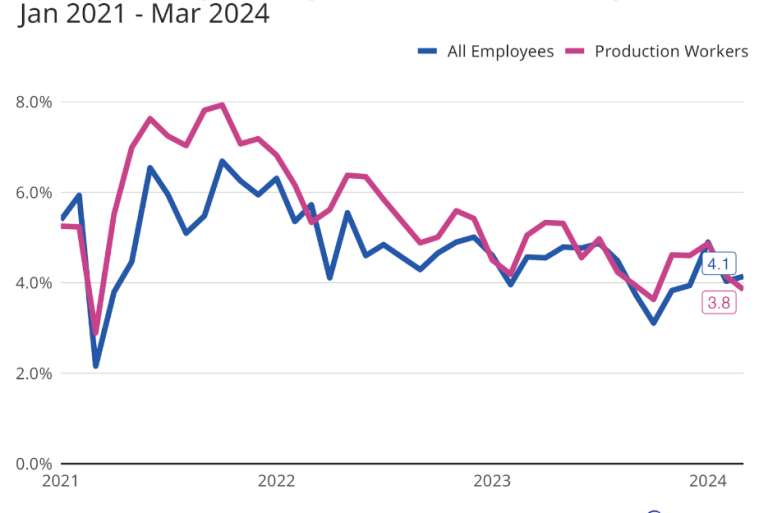
Wage growth has been anything but static over the past few years. Closer examination of the March job report reveals critical insights for recruiters. Between January 2021 and March 2024, there was an increase in the hourly earnings across the board. Marked by economic recovery efforts, employers seemed willing to pay a premium for essential roles. For recruitment professionals, this initial surge created an urgent need to secure talent in a market willing to pay for it. This was known in 2021 as the “Great WTAF?”.
As the economy began to stabilize, the surge in wage growth began a gradual descent. The trend lines for all employees and production workers, after their distinct rise, followed a synchronized wave of fluctuations, signaling a shift towards market equilibrium. This trajectory underscores a pivotal lesson for recruiters: the importance of staying abreast of economic shifts that directly impact salary expectations. Understanding these patterns is crucial when advising clients on competitive compensation strategies to attract and retain the right talent.
By the close of the observed period, the graph shows wage growth rates for both demographics approaching parity. This indicates a maturing job market where wages are normalizing, suggesting a balanced approach to salary offerings is now more appropriate.
Recruiters should take this as a sign to refine their strategies. The may indicate the salary packages being offer should align with this new phase of market maturity. It’s a reminder that while competitive salaries are not the only key to attracting top talent. An informed, data-driven approach to compensation will be the key to success in this more stabilized economic era.
Concluding Insights
The March Job Report for 2024 offers a detailed snapshot of an evolving economy, marked by robust job growth, sectoral shifts, and the emergence of new workforce trends. For businesses and professionals alike, understanding and adapting to these trends is crucial for navigating the future job market successfully. As we look ahead, the insights from the March job report will undoubtedly play a pivotal role in shaping strategic decisions and fostering a resilient, forward-looking workforce.