If you don't collect any metrics, you're flying blind. Collect and obsess over too many, and they'll obstruct your field of view. I didn't come up with that line — project management author Scott M. Graffius did — but it's basically the epigraph over my entire recruiting career.
Most talent acquisition teams measure the wrong things, and I say that as someone who used to be one of them.
Time-to-Fill Isn't the Problem. Making It the Only Story Is.
Every recruiting leader gets asked about time-to-fill and number of hires. Those numbers matter — I'm not going to pretend otherwise. But treating them as the whole dashboard is like a pilot flying with only an altimeter. You know how high you are. You have no idea if you're about to hit something.
SHRM's research on quality of hire makes the uncomfortable point directly: efficiency metrics like time-to-fill and cost-per-hire tell you whether you moved fast. They tell you nothing about whether you got it right. My team and I run on the Sprint Recruiting methodology — two-week cycles, prioritized by points our clients assign to their most critical roles — and the metrics that actually run our operation are the ones almost nobody else is publishing "how-to" guides on. If you want the full breakdown of how the cadence itself works, I laid it out here: "What Is Sprint Recruiting?". Here's what's on my dashboard, built in Google Data Studio, and why each piece earns its spot.
“If you don’t collect any metrics, you’re flying blind. If you collect and focus on too many, they may be obstructing your field of view.”
― Scott M. Graffius
The Candidate Funnel: My Monday Morning Pulse Check
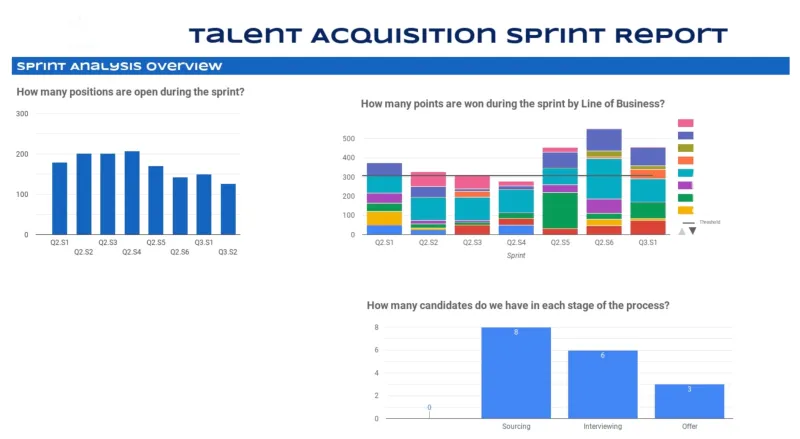
At the start of every week, I want to know exactly how many candidates sit in each stage of the process. Under this two-week cadence, we work against a set of priority positions our clients have assigned points to. Those points dictate where recruiters put their sourcing energy first.
That funnel view — sourcing, active interviews, offers out — is my pulse check. Say I'm looking at 8 jobs being sourced, 6 in active interview stages, and 3 offers out. Early in the sprint, that's a great position. The Wednesday before a sprint closes, that same picture should worry me — a stack of jobs still in sourcing with no candidates moving is a signal, not a coincidence.
As the leader, this is where I decide who on my team needs help and what's actually blocking them. Maybe the market shifted under us. Maybe a client's requirements moved without telling anyone. Either way, this view tells me where to spend my energy before the sprint ends, not after.
Sprint Points: The Number That Keeps Everyone Honest
In our sprint model, clients assign a budgeted number of points biweekly to prioritize the work, and we earn those points by filling the roles attached to them. My team set a threshold of 300 points per sprint as our baseline for success.
Depending on which day of the sprint I check this number, I'm either energized or uneasy — and that's the point. If we're not at least halfway to threshold by mid-sprint, that number tells me to dig deeper in my one-on-ones, not wait for the retro. This single metric has made those conversations sharper and far less speculative than "how's it going?"
Volume by Line of Business: My Early-Warning System
We also track the number of open positions inside each sprint, broken out by line of business. This is how we catch trend shifts before they become fires — a spike in one area, a slow creep in another.
When I see volume climbing, I'm asking:
- Is this a special project that needs real headcount, or a symptom?
- What's the turnover data underneath this — is this backfill in disguise?
- Did the market or industry shift, and how fast can we move to stay ahead of it?
- Does anyone on the team have the capacity to absorb this?
Before we adopted this rhythm, I was making these calls on gut instinct. Now the data sits in front of me daily, and I move faster because of it — not because a dashboard is magic, but because I'm not waiting for a crisis to notice a pattern.
Quick Quits: The Metric Most TA Teams Never Look At
I'm consistently surprised by how many recruiting teams stop measuring the moment the offer is signed. I track what I call "Quick Quits" — candidates who leave within their first six months on the job.
I'm not alone in thinking this matters. Deloitte's research on new-hire onboarding puts a real number on it: roughly one-third of new hires leave within six months of joining. That's not a rounding error — that's a third of your placements walking back out the door, and if you're only measuring time-to-fill and hires against goal, you'll never see it coming.
There's noise in this data, so I filter it: I'm not looking at every termination, only the ones where the candidate decided we weren't the right fit for them. If involuntary terminations spike in a specific line of business, that's my cue to sit down with those leaders and figure out where the mismatch started — whether the role changed, the market shifted, or our screening missed something. Tracking this has let me spend more time recruiting the right people instead of just filling seats, and it's done more for my credibility with clients than any time-to-fill report ever has.
The Experience
If you're not surveying both candidates and hiring managers after every fill, you're missing a data set that predicts almost everything else on this list. We send quarterly surveys — a simple 1-to-5 scale — captured through Google Forms and pulled into the same dashboard.
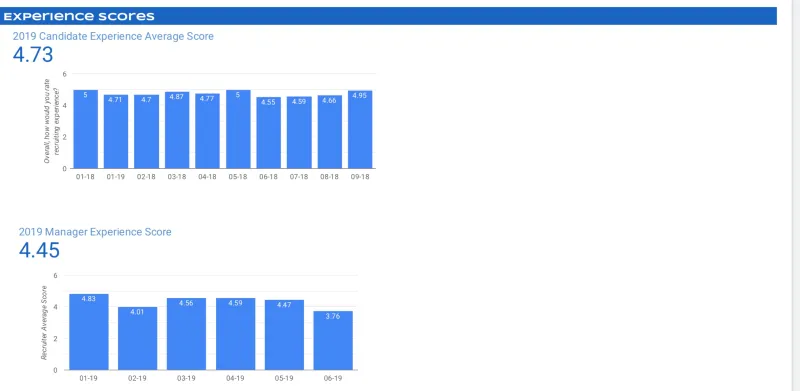
Candidate experience isn't a soft metric. Forbes has covered how a strong candidate experience is becoming a genuine competitive edge in a market where the best people have options and long memories. I also break this data down by line of business and by recruiter — a view I keep internal — so I can catch issues proactively instead of finding out about them in an exit interview or, worse, a client call.
Every two weeks, during our retrospective, we sit with this data and ask what obstacle we can remove before the next cycle. That cadence is the whole point — a survey nobody reviews is just a folder of good intentions.
Where This Leaves You
Time-to-fill and hires-against-goal aren't going away, and there's no shortage of content telling you how to track those. What I wanted to share is the layer underneath — the metrics my team has built our sprint rhythm around, and the early wins that came from watching them.
And if you want to see how Sprint Recruiting actually runs week to week, let's schedule an initial consultation.
FAQ
What is Sprint Recruiting? Sprint Recruiting — the methodology I reference throughout this post — is a two-week cycle where clients assign point values to prioritize open roles, and recruiting teams focus sourcing and interview effort against a points threshold rather than a flat headcount goal.
Why isn't time-to-fill enough on its own? Time-to-fill tells you how fast you moved, not whether the hire was the right one. Teams that optimize hard for speed alone often see it show up later as early turnover or poor quality of hire.
What's a "Quick Quit" and why does it matter? A Quick Quit is a new hire who leaves within their first six months — specifically when the departure signals a fit problem rather than an unrelated life event. Tracking this surfaces sourcing and screening issues that time-to-fill will never show you.
How often should I review these metrics? Weekly for the candidate funnel and sprint points, biweekly for volume by line of business (tied to your sprint cadence), and quarterly for candidate/manager experience surveys and Quick Quit trends.
What tools do I need to build this dashboard? Nothing exotic. My team runs this on Google Sheets for raw tracking, Google Forms for surveys, and Google Data Studio to visualize it. The tools matter far less than the discipline of reviewing the data on a fixed cadence.
Do I need Sprint Recruiting specifically to use these metrics? No — Quick Quits, candidate funnel visibility, and experience surveys are portable to any recruiting model. Sprint Recruiting is simply the cadence my team uses to force the review to actually happen.